
Both a dental bridge and a dental implant replace a missing tooth, but they work in very different ways, and the right choice depends on your bone volume, the condition of your neighbouring teeth, and what matters most to you, whether that’s speed, upfront cost, or something else. DRA Dental in Antalya, Turkey offers both as genuine treatment options, and this guide explains honestly how they compare, without steering you toward the more profitable option.
Key Takeaways
- A dental bridge replaces a missing tooth by anchoring a false tooth to the two neighbouring natural teeth, which are reshaped and crowned
- A dental implant replaces the tooth root itself with a titanium fixture, leaving neighbouring teeth untouched
- Bridges are typically faster and lower-cost upfront; implants preserve more of your natural tooth structure — done properly, both can last many years
- DRA Dental doesn’t default to one option — your dental team plans and recommends whichever fits your specific case, and delivers it to the same clinical standard either way
- Results may vary based on individual assessment; send your X-rays or photos via WhatsApp for a case-specific recommendation
What Is a Dental Bridge?
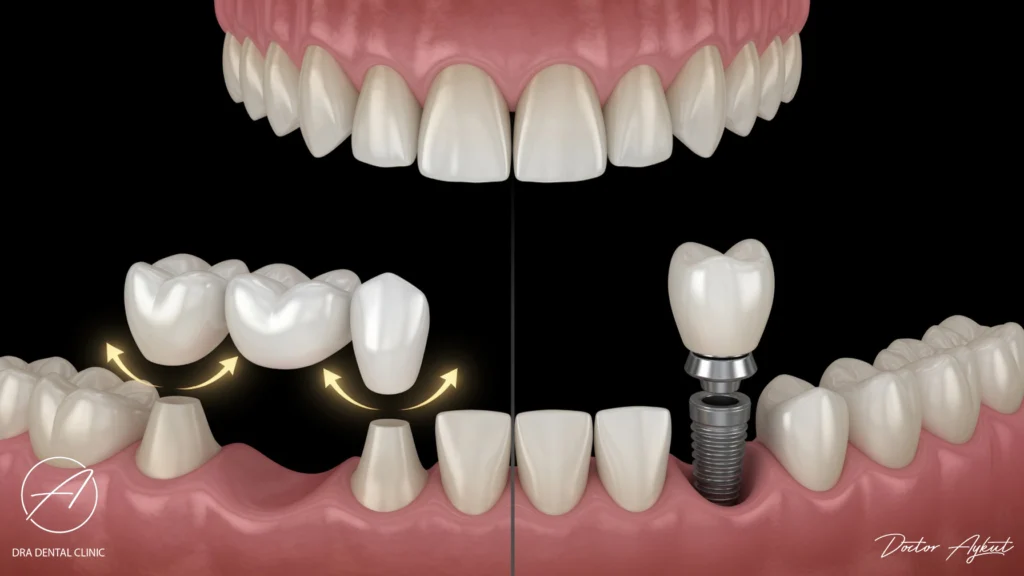
A traditional dental bridge replaces a missing tooth using the two natural teeth on either side of the gap. Those neighbouring teeth are prepared and crowned, and a false tooth (the pontic) is cemented in the space between, held in place by the two crowns. Unlike an implant, no surgery is needed, the whole restoration is built on your existing teeth.
DRA Dental offers this as a traditional, tooth-supported bridge, a real and established treatment option, not a fallback offered only when implants aren’t available. NHS-affiliated guidance from Leeds Teaching Hospitals notes that around 80% of conventional bridges last ten years or longer with relatively minor complications, a useful independent benchmark for the lifespan figures in the comparison below.
What Is a Dental Implant?
A dental implant replaces the missing tooth’s root directly, a titanium fixture is placed into the jawbone and left to fuse with the bone over three to six months (osseointegration), before a crown is fitted on top. Because the implant provides its own foundation, neighbouring teeth are left completely untouched.
A frequently cited long-term study published via PubMed puts implant survival at over 95% at the ten-year mark when properly placed and maintained. For a fuller explanation of the procedure itself, see our dental implants page.
Dental Bridge vs Implant in Turkey: A Direct Comparison
| Factor | Dental Bridge | Dental Implant |
|---|---|---|
| Timeline | Typically completed in one visit of around 5 days | Two visits, roughly 5 days each, 3–6 months apart for osseointegration |
| Effect on neighbouring teeth | Neighbouring teeth are reshaped and crowned, irreversible | Neighbouring teeth are untouched |
| Candidacy | Suitable if neighbouring teeth already need crowns, or patient isn’t a candidate for surgery | Requires adequate bone volume; bone regeneration techniques or sinus lifting can help where needed |
| Request a Free Quote → | ||
Neither option is universally “better”, they solve the same problem in structurally different ways, with different trade-offs.
When a Bridge Makes Sense
A bridge is a genuinely sound choice in several situations:
- Your neighbouring teeth already need crowns for other reasons, in which case a bridge solves two problems with one restoration, rather than treating them separately
- You aren’t a candidate for surgery, or would prefer not to have one
- You want a faster, lower upfront-cost solution
Helen, a 58-year-old patient from Cardiff, came to DRA Dental in 2026 already needing crowns on both teeth next to a missing molar following an old root canal treatment. Rather than recommending an implant that would have left two healthy crown candidates untouched, our dental team walked her through why a bridge made more clinical sense for her specific case, treating three problems as one coordinated restoration instead of two separate procedures.
When an Implant Makes More Sense
An implant may be the better fit for your case when:
- Your neighbouring teeth are healthy and you’d prefer not to have them reshaped
- You have, or can achieve with treatment, adequate bone volume at the implant site
A Note on Cost
As a general rule across the industry, an implant carries a higher upfront cost than a bridge, largely because of the surgical placement stage and the months-long healing period involved. A bridge is the more affordable option upfront, avoiding both of those stages.
As a general guide, a traditional bridge typically costs roughly half of the equivalent implant treatment, though the exact figure depends on the length of the bridge and the number of teeth (units) it spans. Your dental team will give you a specific written cost for your case once your neighbouring teeth and the gap itself have been assessed, rather than a generic figure that may not reflect your situation.
Recovery and Aftercare: What to Expect With Each
The day-to-day experience of recovering from a bridge is different from recovering from an implant, and it’s worth understanding both before deciding.
With a bridge: because there’s no surgery involved, recovery is mainly about the neighbouring teeth adjusting to their new crowns. Mild sensitivity for a few days is common, and the bridge itself is fully functional and final by the time you leave Antalya, there’s no waiting period before it can bear normal biting force.
With an implant: the surgical site needs time to heal before the implant is loaded with a permanent crown. Some swelling and tenderness in the days immediately after placement is normal, followed by the three-to-six month osseointegration period during which the temporary restoration (where one is fitted, depending on bone quality and primary stability) does the day-to-day work while the implant fuses with the jawbone.
In both cases, our dental team is reachable by WhatsApp after you return home if you have any questions about how the restoration is settling in.
What DRA Dental Recommends in Antalya, Turkey
DRA Dental doesn’t default to one option for every missing tooth. Your dental team looks at your bone structure, the condition of your neighbouring teeth, and what matters most to you, then plans and recommends whichever option is genuinely the right fit for your case, delivered to the same clinical standard either way.
Results may vary based on individual assessment, which is why this decision is made after reviewing your specific bone structure and dental history, not from a generic recommendation.
You can also read what our patients say about their experience at DRA Dental to see how this kind of case-by-case decision has worked out for others.
Not sure which option applies to your case? Send your X-rays or photos via WhatsApp, and our team will give you an honest, case-specific recommendation, no obligation.
Frequently Asked Questions
Is a dental bridge cheaper than an implant in Turkey?
A dental bridge is generally lower-cost upfront and faster to complete than an implant, which requires a second visit several months later for the permanent crown. An implant carries a higher initial cost, tied to the surgical placement stage and healing period involved.
How long does a dental bridge last compared to an implant?
Done properly and looked after well, both a bridge and an implant can last many years, published data shows over 95% implant survival at the ten-year mark, and NHS-affiliated guidance puts conventional bridge survival at around 80% at ten years. Neither is automatically the longer-lasting option; how well it’s placed and maintained matters more than which one you choose.
Can I get a bridge if I don’t have enough bone for an implant?
Yes. A bridge doesn’t rely on jawbone volume at the missing tooth site the way an implant does, since it’s supported by the neighbouring natural teeth instead. This makes it a relevant option for patients where implant candidacy is uncertain, though our dental team can also assess whether bone regeneration techniques could make an implant viable.
Does a bridge damage my neighbouring teeth?
The neighbouring teeth are reshaped to accept crowns as part of the bridge, which is an irreversible step. This is a standard, well-established part of the procedure, not damage in the sense of harm, but it is a permanent change worth understanding before choosing a bridge over an implant.
Can a bridge be replaced with an implant later if I change my mind?
In many cases, yes, though it depends on the condition of the neighbouring teeth and the bone at the original site by that point. If you’re weighing this as a future possibility, mention it during your consultation so our dental team can factor it into their recommendation now.
Where is DRA Dental Clinic located?
DRA Dental Clinic is located in Kundu, Lara Beach, Antalya, Turkey.



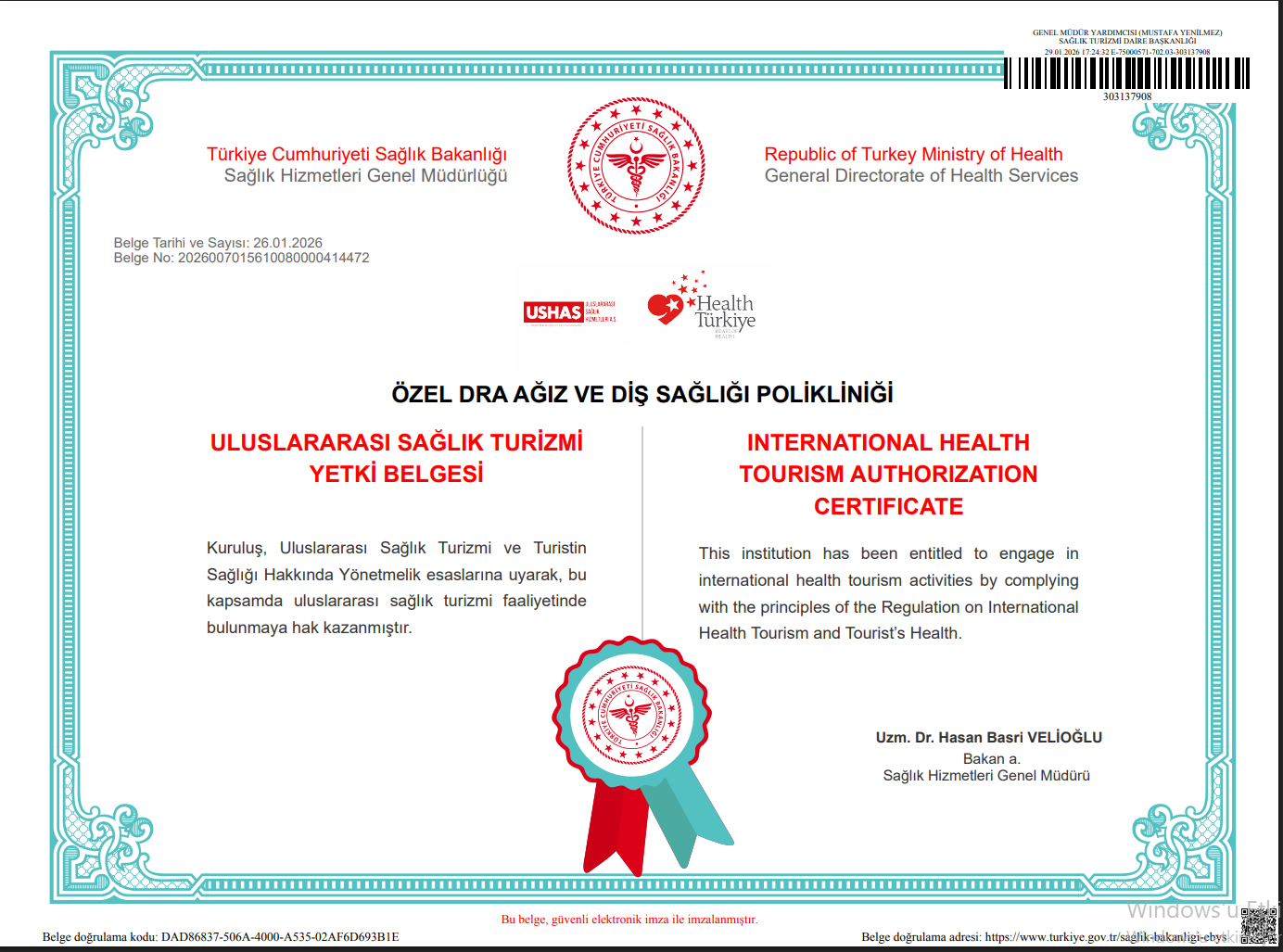
Part of Türkiye's Official Health Tourism Program

Ministry of Health Authorization Certificate
Making the Right Choice for Your Case
There’s no universally correct answer between a dental bridge and a dental implant, only the right answer for your specific bone structure, your neighbouring teeth, and what you’re prioritising between speed, cost, and other factors. DRA Dental doesn’t default to one option, your dental team plans and recommends whichever is genuinely right for your case, and delivers it properly either way.
Send your X-rays or a photo of the gap via WhatsApp, or book a video consultation, and our dental team will give you a clear, honest recommendation before you travel.