
Veneers and crowns are the two main restoration options for a cosmetic smile design. Both change the appearance of your teeth. Both can be made from ceramic materials that closely mimic natural tooth colour and translucency. But they differ significantly in how they are placed, how they distribute load across the tooth, and — most importantly — how long they last in clinical practice. This guide sets out the honest differences between the two, explains what the research says about longevity, and describes how DRA Dental Clinic approaches the choice between them.
Key Takeaways
- Crowns cover the entire tooth surface; veneers cover only the front surface — the difference affects long-term durability and stability
- Published clinical data shows that crowns consistently outlast veneers and composite bonding in long-term outcome studies
- Composite bonding and laminate veneers carry a higher risk of chipping, cracking, and detachment compared to full crowns
- DRA Dental Clinic recommends zirconia crowns as the most durable and reliable cosmetic restoration for smile design cases
- Laminate veneers and composite bonding are available at DRA Dental where clinically appropriate
- Send photos and existing X-rays via WhatsApp for a case assessment and written cost estimate at no charge
What Is a Veneer?
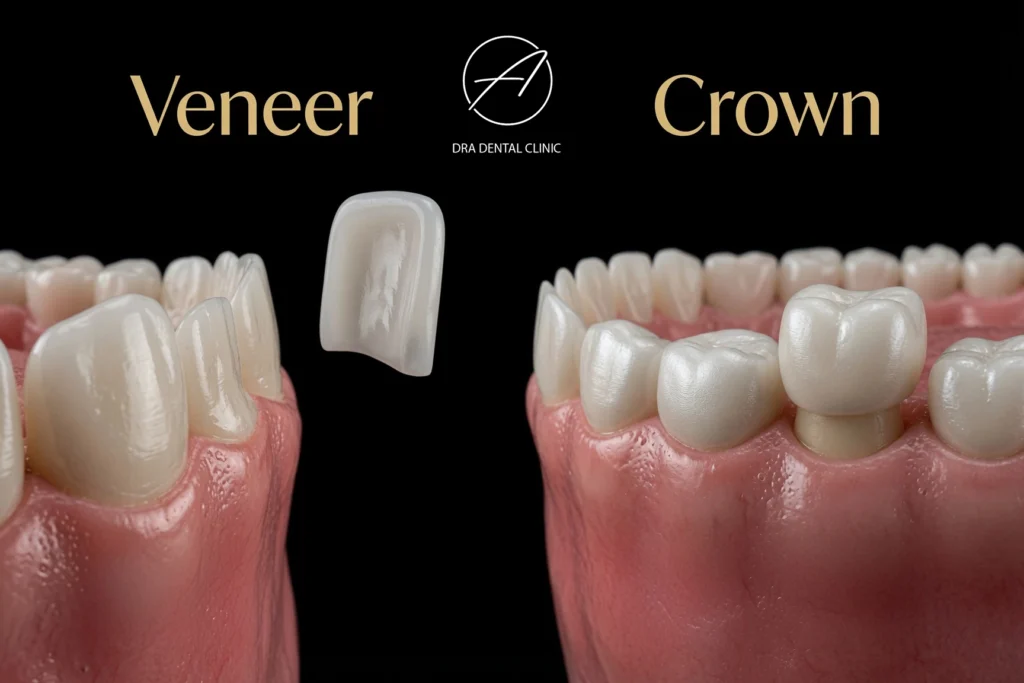
A veneer is a thin shell of ceramic or resin bonded to the front surface of a tooth. The tooth surface is prepared before the veneer is applied — the amount of preparation varies by the type of veneer.
Porcelain laminate veneers are made from thin fired ceramic. They require the removal of a small amount of enamel from the front of the tooth to create space for the veneer to sit flush with the neighboring teeth. Once bonded, a laminate veneer covers only the front face of the tooth; the back and sides remain exposed.
Composite bonding is a chairside procedure where tooth-coloured resin is applied directly to the tooth surface and sculpted in a single appointment. No laboratory fabrication is required. The resin covers the visible surfaces of the teeth to change their shape or colour.
Both options are used in cosmetic dentistry. Neither is a temporary fix, but both have a shorter expected clinical lifespan than a well-placed crown.
What Is a Crown?
A crown is a ceramic cap that covers the entire external surface of a tooth from the gum line upward. The tooth is prepared by reshaping it to receive the crown, and the crown is then cemented over the entire tooth structure.
Zirconia crowns are made from a high-strength dental ceramic. New-generation multilayer zirconia matches the aesthetic quality of E-max porcelain while offering superior strength and durability. Zirconia’s mechanical properties make it resistant to fracture under the high biting forces exerted on posterior teeth.
E-max crowns are lithium disilicate all-ceramic restorations known for their natural translucency and aesthetic quality. Widely used for anterior (front) teeth where optical properties are the priority.
A crown fully encases the tooth, distributing biting forces across the entire crown surface and down through the prepared tooth structure.
Durability: What the Evidence Shows
Longevity data for dental restorations comes from clinical outcome studies tracking patients over years and decades. The picture that emerges is consistent: full crowns outlast veneers and composite bonding in the vast majority of published studies.
Composite bonding has the shortest expected lifespan of the three. Studies tracking composite restorations over five to ten years report failure rates — including chipping, fracture, or need for replacement — that are significantly higher than for ceramic options. The resin material is softer than ceramic and more susceptible to staining and wear over time.
Laminate veneers perform better than composite bonding over the medium term but carry a higher risk of fracture and detachment than full crowns. Research published in clinical literature consistently reports higher long-term failure rates for laminate veneers compared to crowns in full-arch or whole-smile cases. The front-surface-only bonding means the restoration is more vulnerable to forces applied at an angle or from behind.
Crowns have the longest documented clinical lifespans. When correctly fabricated and placed, a zirconia or E-max crown can be expected to function for fifteen or more years. The full-coverage design means force is distributed across the entire tooth, and the restoration is retained through the shape of the prepared tooth as well as the cement bond.
The clinical conclusion is consistent with DRA Dental’s approach: for full smile design cases where durability is the priority, crowns are the most reliable choice.
Why Less Tooth Preparation Is Not Always Better
A common assumption in cosmetic dentistry is that less preparation is always preferable — that preserving more tooth structure is inherently a better clinical outcome. This assumption is worth examining.
Tooth preparation for a crown does involve reshaping the tooth to receive a full-coverage restoration. The extent of this depends on the tooth’s existing shape and the space available. However, the amount of tooth preparation does not determine the quality of the outcome. A well-placed crown on a properly prepared tooth is a durable, stable restoration that protects the underlying tooth structure for many years.
A laminate veneer requires less preparation than a crown. But this does not make the veneer a clinically superior choice. If the veneer chips, fractures, or detaches within five to eight years — which clinical data shows happens at higher rates than with crowns — the patient faces either repair or replacement, potentially involving more extensive work on a tooth that has already been prepared.
For patients travelling from the UK to Turkey for treatment, the longevity of the restoration is particularly relevant. A restoration that lasts fifteen or more years is a better investment than one that may require attention within a few years — regardless of how much preparation was involved in placing it.
DRA Dental’s Clinical Recommendation
DRA Dental recommends zirconia crowns as the most durable and reliable cosmetic restoration for smile design cases. E-max is available for specific clinical situations where the treating team recommends it. This is a clinical position based on long-term outcome data and our experience treating patients who have travelled specifically for the quality and longevity of their results.
Composite bonding and laminate veneers carry a higher risk of chipping, cracking, and detachment compared to full crowns. Where these restorations are the most clinically appropriate option for a patient’s specific situation — the teeth involved, the bite, the case complexity — they are available at DRA Dental. But they are not our standard recommendation for full smile design cases.
New-generation multilayer zirconia matches E-max aesthetically while offering superior strength and durability. DRA Dental uses German Zirconia from Dental Direkt for all zirconia crown fabrication. For patients who want the best long-term cosmetic outcome from a single treatment visit to Antalya, zirconia crowns are the restorations DRA Dental recommends.
See the full smile design page at DRA Dental for what the treatment involves.
A Practical Comparison
| Factor | Composite Bonding | Laminate Veneers | Zirconia / E-max Crown |
|---|---|---|---|
| Coverage | Front surface (resin) | Front surface (ceramic shell) | Full tooth coverage |
| Expected lifespan | 5–7 years | 8–12 years | 15+ years |
| Risk of chipping/fracture | Higher | Moderate | Lower |
| Aesthetic quality | Good | Very good | Excellent |
| Tooth preparation required | Minimal | Front surface enamel | Full reshaping |
| DRA Dental recommendation | Where clinically indicated | Where clinically indicated | Standard recommendation |
What About Gum Design?
If the gum line is uneven, a gum design procedure may be recommended alongside a smile makeover — regardless of whether crowns or veneers are used. Gum design at DRA Dental involves reshaping the gum tissue using electrocautery to create a balanced, symmetrical frame for the new restorations. When included, it adds one or two appointments to the treatment schedule.
Professional teeth cleaning and whitening may also be recommended before restorative work begins, particularly when composite bonding is the chosen treatment.
The Treatment Process at DRA Dental
A crown-based smile design at DRA Dental Clinic in Antalya is completed in five days.
Before you travel: Send photos of your smile and any existing dental X-rays via WhatsApp. DRA Dental will review your case, confirm which restoration is appropriate, and provide a written cost estimate at no charge.
Day 1: Arrival consultation, digital photographs, and a panoramic X-ray. The treatment plan is confirmed. Tooth preparation, impressions, and temporary crowns begin the same day if you are ready to proceed.
Days 2–3: The dental laboratory fabricates the trial restorations.
Day 4: Permanent restorations are assessed for fit, colour, and bite. Final bonding.
Day 5: Final check. You fly home with your completed smile. Smile design restorations carry a ten-year guarantee at DRA Dental.
Frequently Asked Questions
Do veneers or crowns last longer?
Crowns consistently outlast veneers in published clinical outcome studies. A well-placed zirconia or E-max crown can be expected to function for fifteen or more years. Laminate veneers typically last eight to twelve years with proper care before showing wear or requiring replacement. Composite bonding has the shortest clinical lifespan of the three, typically five to seven years.
What does DRA Dental recommend for smile design?
DRA Dental recommends zirconia crowns as the most durable and reliable cosmetic restoration for smile design cases. E-max is available where specifically indicated. Composite bonding and laminate veneers carry a higher risk of chipping, cracking, and detachment over time. They are available where clinically appropriate.
Are veneers suitable for people who grind their teeth?
Bruxism (tooth grinding) significantly increases the risk of veneer fracture. Patients who grind their teeth are generally not good candidates for laminate veneers or composite bonding. Full crowns are significantly more resistant to fracture forces. A night guard is recommended after any cosmetic restoration to protect the investment.
Can veneers be placed over damaged or decayed teeth?
No. Veneers require a structurally sound tooth with sufficient enamel for bonding. Teeth with decay, cracks, or existing large fillings generally require crown treatment instead. DRA Dental’s team will assess whether veneers are clinically appropriate during the initial case review.
How much do crowns cost compared to veneers in Turkey?
The per-unit price for a crown is slightly higher than for a laminate veneer, reflecting the greater laboratory work involved. However, when longevity is factored in — a crown lasting fifteen or more years versus a veneer lasting eight to twelve — the long-term cost per year of the restoration is comparable or lower for crowns. Contact DRA Dental for a personalised quote.
What is the ten-year guarantee?
DRA Dental provides a ten-year guarantee on smile design restorations. This is confirmed in writing before treatment begins and covers the clinical work carried out at the clinic.
Can I switch from veneers to crowns later if I change my mind?
Once a tooth has been prepared for a veneer, it is committed to having a veneer or crown for the rest of its life — the preparation is irreversible. It is possible to transition from a veneer to a crown later, but this involves further preparation. The choice of restoration at the outset matters.
Where is DRA Dental Clinic located?
DRA Dental Clinic is located in Kundu, Lara Beach, Antalya, Turkey — approximately ten minutes from Antalya Airport. Airport transfers can be arranged by the clinic.



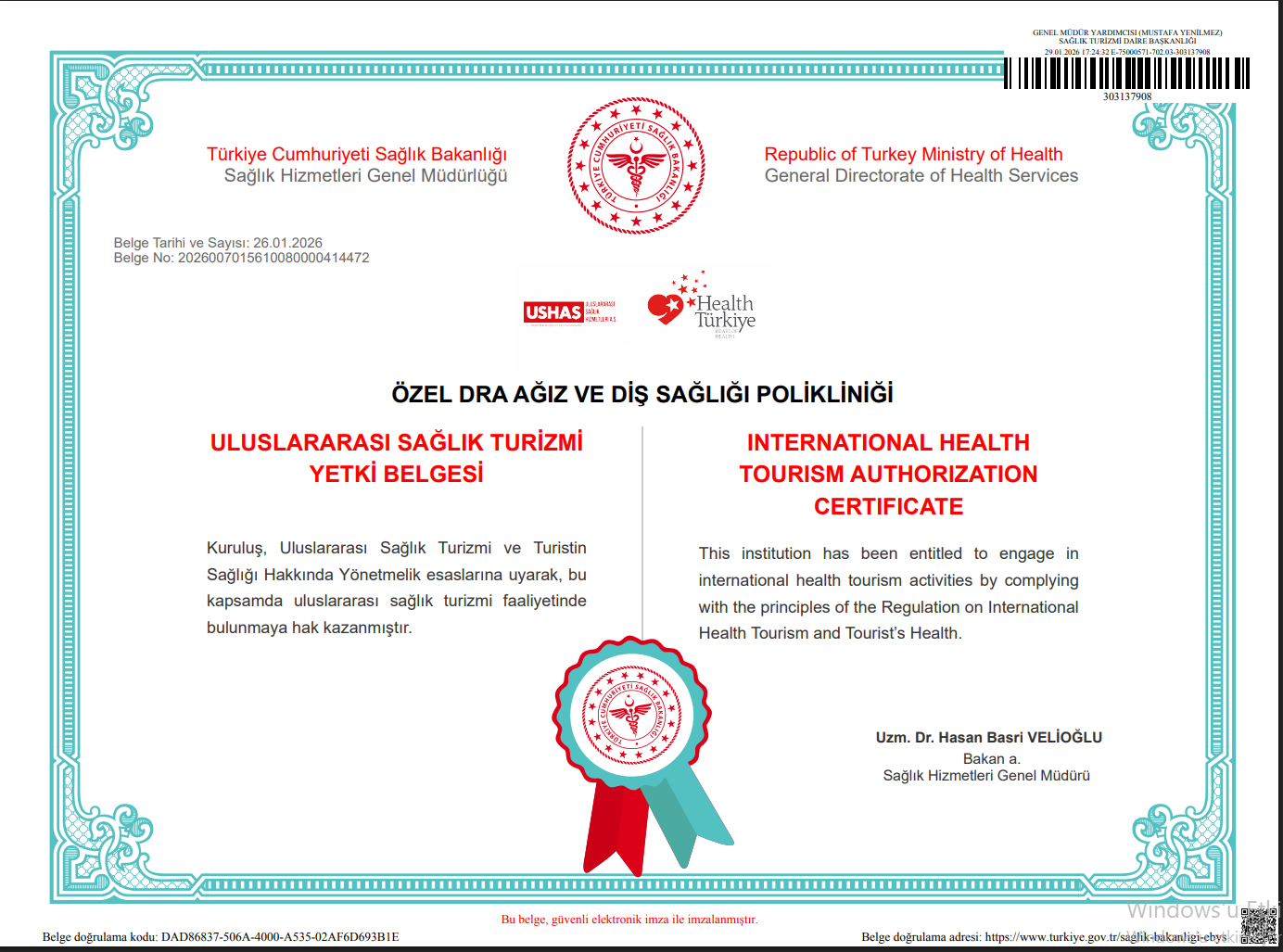
Part of Türkiye's Official Health Tourism Program

Ministry of Health Authorization Certificate
Find Out Which Option Is Right for Your Case
Send photos of your current smile and any existing X-rays via WhatsApp. Our dental team will review your teeth, assess which restoration is the most appropriate clinical choice, and provide a written cost estimate.
Get a free assessment from DRA Dental →
Or contact us directly: +44 7570 442248 (WhatsApp and phone)