
A dental implant is the only tooth replacement option that integrates directly with the jawbone. When an implant successfully osseointegrates — when the titanium fuses with the surrounding bone — it functions as a stable root for a crown or bridge with a clinical lifespan that exceeds any other tooth replacement option available. The question patients most frequently ask is how long this actually lasts in practice. This guide sets out what the clinical evidence shows, which factors most affect implant longevity, and what the process looks like at DRA Dental Clinic in Antalya.
Key Takeaways
- Published clinical studies report implant survival rates of 95% or above at ten years; data from studies extending beyond twenty years shows high long-term survival in well-maintained patients
- The implant itself (the titanium root) is designed for lifelong function; the crown or bridge attached to it has a separate expected lifespan
- Smoking is the single most significant modifiable risk factor for implant failure
- Uncontrolled diabetes, gum disease, and poor oral hygiene substantially increase failure risk
- DRA Dental uses Osstem implants — CE-marked, FDA-approved, South Korean-manufactured titanium implants with an extensive peer-reviewed clinical track record
- Bone structure is assessed with a panoramic X-ray before treatment begins — DRA Dental will not recommend implant placement until your anatomy has been directly reviewed
What the Clinical Evidence Shows
Dental implant longevity is one of the better-studied areas in clinical dentistry. Systematic reviews and meta-analyses have tracked implant outcomes across large patient populations over extended follow-up periods.
Five-year data from published systematic reviews consistently reports implant survival rates of 96–98%. The primary causes of early failure — within the first year — are failure to osseointegrate, infection, and peri-implantitis (inflammation of the tissue surrounding the implant).
Ten-year data shows survival rates typically in the range of 93–97%. Long-term success — which includes function, bone stability, and the absence of complications — is slightly lower than survival, but remains high in compliant patients.
Twenty-year and beyond data is available from long-term cohort studies. These show that implants placed in suitable patients, with good oral hygiene maintained over time, can function for decades. Some studies report survival rates above 90% at twenty years for patients with no significant risk factors.
These are not theoretical figures. They reflect outcomes from patients across different clinical settings, implant systems, and populations. The figures do not mean every implant lasts forever — some fail, and failure rates are meaningfully higher in patients with significant risk factors. But for most suitable patients, an implant placed today is expected to function for the rest of their life.
The Implant vs the Crown: Two Different Lifespans
It is important to distinguish between two separate components:
The implant fixture — the titanium screw that integrates with the jawbone — is designed for permanent function. In the absence of significant bone loss or systemic health changes, a well-integrated implant does not typically need to be replaced. The titanium material is biologically inert and does not degrade in the body.
The crown or bridge attached to the implant has a separate expected lifespan. A zirconia or ceramic crown on a single implant typically lasts fifteen or more years, with some patients getting significantly longer. Full-arch bridges — as used in All-on-6 treatment — have a similarly long expected lifespan when well maintained, though the complexity of the structure means wear, fracture, or the need for minor adjustments over decades is possible.
When a crown on an implant fails, the implant itself may remain intact and be suitable for a new crown. Replacing a crown is substantially simpler and less expensive than replacing an implant.
Factors That Affect Implant Longevity
Smoking
Smoking is the most significant modifiable risk factor for implant failure. The mechanisms are well established: smoking impairs blood flow to the gum tissue, slows healing after implant placement, and increases the risk of peri-implantitis over the long term. Implant failure rates in smokers are consistently two to three times higher than in non-smokers in published studies.
Patients who smoke are asked to stop for a minimum of two weeks before and after surgery. Continued smoking throughout the osseointegration period (the three to six months between visits at DRA Dental) significantly increases the risk of failure. This is communicated to all patients before treatment begins.
Oral Hygiene
The long-term survival of an implant depends heavily on the health of the surrounding tissue. Peri-implantitis — bacterial infection and inflammation around the implant — is the leading cause of late implant failure. It is driven by the same bacterial accumulation that causes gum disease in natural teeth, and it is largely preventable with consistent oral hygiene.
Cleaning around implants requires specific techniques. Implants cannot develop decay the way natural teeth can, but the tissue around them must be kept clean. Interdental brushes, water flossers, and regular professional hygiene appointments are the standard recommended maintenance regime.
Bone Density and Volume
The amount and quality of bone at the implant site at the time of placement affects both the success of initial osseointegration and the long-term stability of the implant. Implants placed in adequate bone density with good primary stability — the mechanical grip of the implant at the time of surgery — achieve osseointegration at higher rates than those placed in compromised bone.
At DRA Dental, a panoramic X-ray is taken on Day 1 of your first visit to assess bone structure. DRA Dental will not proceed with implant placement until this assessment has been reviewed. For upper jaw cases where bone depth is insufficient for standard implant placement, sinus lifting is available. Where bone regeneration is needed, DRA Dental uses autogenic bone grafts and regeneration techniques rather than synthetic bone grafts.
Systemic Health
Uncontrolled diabetes significantly impairs healing and osseointegration. Patients with well-controlled diabetes can successfully receive implants, but uncontrolled blood glucose is a contraindication. DRA Dental asks about systemic health before treatment planning.
Blood-thinning medications require careful pre-operative assessment. Some medications affect healing or bleeding risk during surgery.
Osteoporosis — and bisphosphonate medications commonly used to treat it — requires specific assessment before implant placement. Patients on bisphosphonates should inform their treating dentist before any implant procedure.
Gum disease must be treated before implants are placed. Active infection in the mouth at the time of surgery increases failure rates substantially.
Implant Quality
Not all implant systems are equivalent. The clinical track record of an implant system — the volume of peer-reviewed research, the consistency of manufacturing standards, and the length of long-term follow-up data — varies significantly between manufacturers.
DRA Dental uses Osstem implants. Osstem is a South Korean implant manufacturer, CE-marked and FDA-approved, with one of the largest published peer-reviewed clinical datasets of any implant company. Osstem implants are used in tens of millions of placements globally. Their longevity data reflects real-world clinical outcomes across diverse patient populations, not just controlled research settings.
The Implant Process at DRA Dental
Full-arch implant treatment at DRA Dental requires two visits to Antalya, with an osseointegration period of three to six months between them.
Visit 1 — Implant Placement (5 Days)
Day 1: Arrival consultation and panoramic X-ray. Bone structure is assessed and the treatment plan confirmed. Extraction of any remaining failing teeth and implant placement can take place the same day. For full mouth treatment, up to twelve Osstem implants (six per arch) are placed in a single surgical session.
Days 2–3: Where bone quality and implant primary stability allow, measurements for a temporary bridge are taken. Whether a temporary prosthesis is fitted depends on the clinical assessment on the day of surgery.
Days 4–5: Recovery. Swelling typically peaks around Day 2–3 and reduces noticeably by Day 4. A final check confirms healing is proceeding well before departure.
Osseointegration at Home (3–6 Months)
The implants fuse with the jawbone during this period. A soft food diet is recommended. A follow-up panoramic X-ray confirms osseointegration before Visit 2 is scheduled.
Visit 2 — Permanent Zirconia Bridge and Gum Shield (5 Days)
Day 1: Temporary bridge removed. Healing caps placed, gum tissue shaped, and impressions taken for the laboratory.
Days 2–3: Rehearsal appointments assess the final fitting and shape.
Days 3–4: Permanent zirconia crowns fitted. Impressions for the gum shield taken at the same appointment.
Day 5: Gum shield delivered. Final check. Departure with the permanent restoration in place.
Aftercare and Long-Term Maintenance
Implant longevity is not determined solely at placement. Long-term maintenance is equally important. For patients returning to the UK after treatment at DRA Dental:
Regular dental hygiene appointments. Twice-yearly professional cleaning around implant sites is standard. The hygienist should be informed that you have implants so that appropriate instruments are used.
Monitoring for peri-implantitis. The early signs — bleeding, swelling, or discomfort around an implant — should be assessed promptly. DRA Dental can advise remotely via WhatsApp if you have concerns after returning home.
Night guard for bruxism. Patients who grind their teeth carry a higher risk of crown fracture and implant stress. A night guard significantly reduces this risk. DRA Dental provides a gum shield (night guard) during Visit 2, delivered on Day 5.
Smoking cessation. Patients who smoke after implant placement carry a higher long-term failure risk than non-smokers. Cessation at any point after implant placement reduces this risk.
Why Choose DRA Dental for Dental Implants?
Osstem implants as standard. CE-marked, FDA-approved, with one of the most extensive peer-reviewed clinical records of any implant system. Other brands available on request.
Panoramic X-ray on Day 1. Bone structure is assessed before any procedure proceeds. DRA Dental will not advise on suitability for implants until your anatomy has been directly reviewed.
Bone regeneration approach. Synthetic bone grafts are not used. Autogenic bone grafts and bone regeneration techniques are applied where required. Sinus lifting is available for upper jaw cases.
All-on-6 recommended as standard. For full-arch cases, DRA Dental recommends six-implant support. All-on-4 is available for patients where bone anatomy makes six implants unsuitable.
UK contact. Reach the DRA Dental team at +44 7570 442248 by phone or WhatsApp before, during, and after treatment.
Sedation available. Patients who prefer not to be awake during implant surgery can discuss sedation options with DRA Dental.
Frequently Asked Questions
How long do dental implants last?
Published clinical studies report implant survival rates of 95% or above at ten years. Long-term data extending to twenty years shows high survival rates in patients with good oral hygiene and no significant systemic risk factors. The titanium implant fixture is designed for lifelong function; the crown or bridge attached to it has a separate expected lifespan of fifteen or more years.
Do implants ever need to be replaced?
The implant fixture itself does not typically need replacement if it successfully integrates and the patient maintains good oral hygiene. The crown or bridge attached to the implant may eventually need replacement — usually after fifteen or more years — but this does not require removing the implant.
What causes dental implants to fail?
The most common causes of failure are: failure to osseointegrate (primarily in patients with systemic conditions or poor bone quality), peri-implantitis (infection of the tissue around the implant, driven by poor oral hygiene or smoking), and late mechanical failure (fracture of the implant or abutment, most commonly in patients with untreated bruxism).
Can smokers get dental implants?
Smokers can receive implants, but failure rates are significantly higher than in non-smokers. Patients are asked to stop smoking for a minimum period before and after surgery and during osseointegration. DRA Dental discusses smoking status with all implant patients before proceeding.
What implants does DRA Dental use?
DRA Dental uses Osstem implants as standard. Osstem is a South Korean manufacturer, CE-marked and FDA-approved, with an extensive peer-reviewed clinical track record. Other implant brands are available on request.
How much does implant treatment cost at DRA Dental?
Implant treatment at DRA Dental costs 60–75% less than equivalent treatment at UK private specialist clinics. The exact cost depends on the number of implants, the implant system, and any preparatory procedures required. Contact DRA Dental with your panoramic X-ray and photos for a personalised written estimate.
Where is DRA Dental Clinic located?
DRA Dental Clinic is located in Kundu, Lara Beach, Antalya, Turkey — approximately ten minutes from Antalya Airport. Airport transfers can be arranged by the clinic.



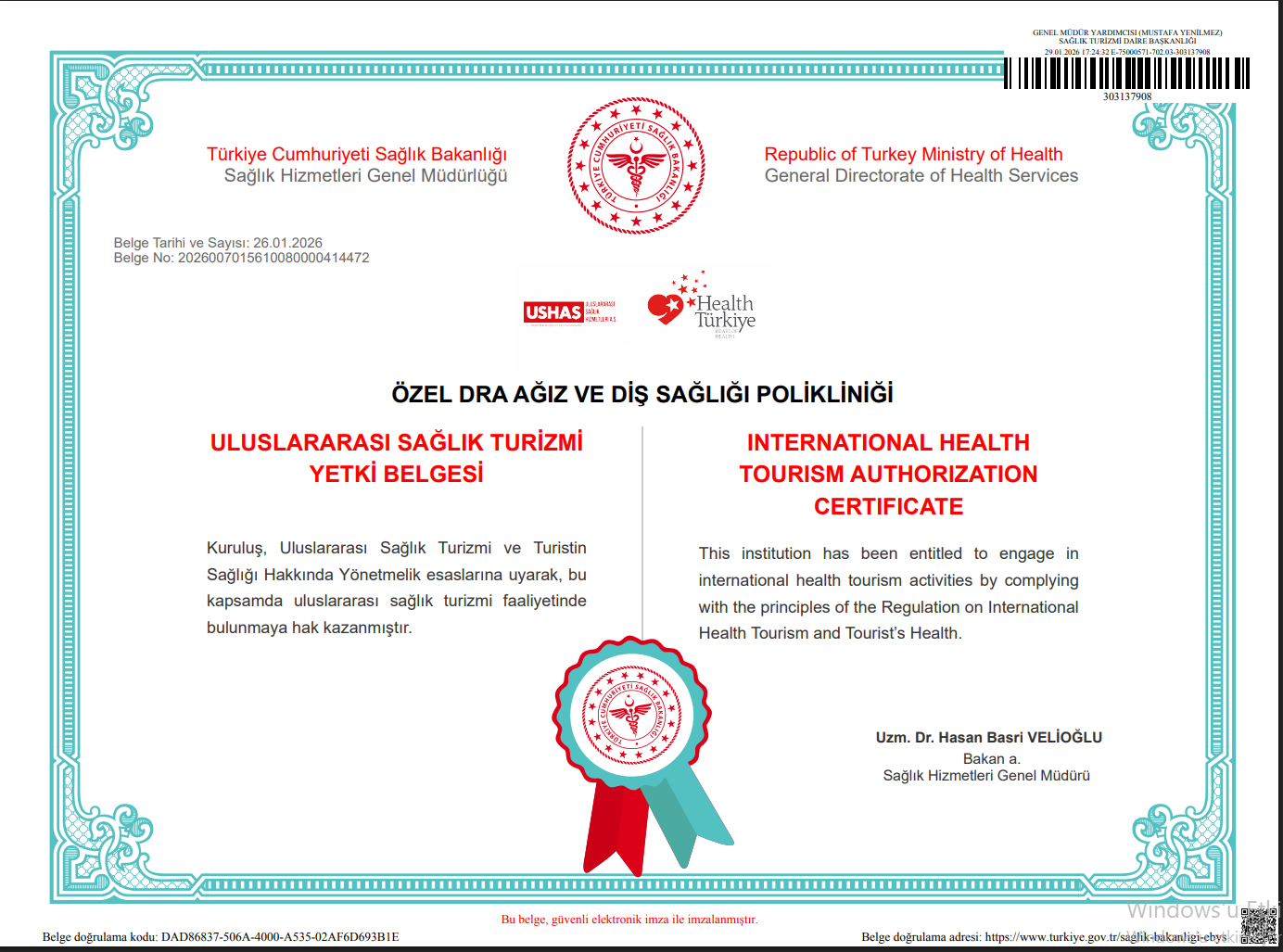
Part of Türkiye's Official Health Tourism Program

Ministry of Health Authorization Certificate
Start With a Suitability Assessment
The most important first step is confirming that implant treatment is appropriate for your bone structure and general health.
Send your existing panoramic X-ray and photos of your current smile via WhatsApp. Our dental team will review your case, confirm suitability, and provide a written cost estimate. No charge. No obligation.
Get a free implant assessment from DRA Dental →
Or contact us directly: +44 7570 442248 (WhatsApp and phone)