
Yes, smokers can get dental implants, but the honest answer doesn’t stop there: smoking measurably increases the risk of implant failure, and DRA Dental would rather explain exactly what that means than gloss over it. Here’s what the actual data shows, why it happens, and what genuinely reduces your risk if you smoke and want implants.
Key Takeaways
- Implant success sits around 95% for non-smokers, compared with roughly 85–90% for smokers, depending on how much and how long they smoke
- Smoking is linked to a significantly higher risk of early implant failure in published research
- Smoking isn’t an automatic disqualifier at DRA Dental — it’s a risk factor assessed on Day 1, not a blanket refusal
- Nicotine and carbon monoxide impair blood flow, which slows the bone-fusing process implants depend on
- Cutting back or pausing smoking around your treatment window measurably improves your odds
How Much Does Smoking Actually Increase Implant Failure Risk?
Published research on this is consistent rather than alarmist. A review of implant outcomes in smokers found overall success around 95% for non-smokers, compared with roughly 85–90% for smokers, varying with how much and how long someone smokes, according to a 2026 review published via PubMed Central. Separate research specifically on early implant failure found smoking associated with substantially higher odds of failure in the first weeks and months, when the implant is at its most vulnerable, according to a literature update via PubMed Central.
That’s a real, meaningful gap, not a rounding error. But it also means the majority of smokers who get implants do heal successfully. This is a risk to understand and manage, not a reason to assume implants are off the table.
Heavier, longer-term smoking tends to carry more risk than lighter or more recent smoking habits, which is one reason a blanket “yes” or “no” answer doesn’t actually serve patients well. Your specific history, how much, how long, and how consistently, matters more than the fact that you smoke at all, and it’s exactly the kind of detail worth discussing honestly with your dental team before you travel rather than after.
Why Smoking Affects Implant Healing
Dental implants rely on osseointegration, the process where the jawbone fuses to the titanium fixture over three to six months. Nicotine and carbon monoxide from smoking reduce blood flow and oxygen delivery to the healing site, which is exactly the environment osseointegration needs to succeed. Smoking is also linked to a higher rate of peri-implantitis, an infection around the implant that can develop later even after successful initial healing.
Paul, a 49-year-old from Glasgow who’d smoked for over 20 years, assumed during his research that implants simply weren’t an option for him. When he messaged our dental team via WhatsApp, they explained the real risk numbers honestly rather than either refusing him outright or downplaying the risk, and talked through what would actually improve his odds. He went ahead with treatment with a clear picture of the trade-offs, rather than either avoiding implants entirely or going in without understanding the risk.
Do You Have to Quit Smoking Before Getting Implants?
Not necessarily, but reducing or pausing smoking around your treatment window measurably helps. The highest-risk period is the weeks immediately after surgery, while osseointegration is establishing itself, so cutting back most strictly during that window matters more than a lifetime commitment made under pressure before you’ve even booked.
Want an honest conversation about your specific situation? Send your case details via WhatsApp, and our dental team will talk through your risk factors without judgment before you commit to travelling.
What DRA Dental Does Differently for Smoking Patients
Being a smoker doesn’t rule you out at DRA Dental, and we’re not going to pretend otherwise to make a sale. What we do instead:
- Day 1 panoramic X-ray, reviewed by our dental team before any surgical step, to assess bone quality directly rather than assume based on smoking history alone
- An honest conversation about your specific risk, based on how much and how long you smoke, not a generic warning
- Practical guidance on reducing risk around your treatment window, rather than an all-or-nothing quit demand
- A written treatment plan that reflects your actual case, not a one-size-fits-all quote
Results may vary based on individual assessment, which is exactly why the Day 1 review, not your smoking history alone, is what shapes your specific treatment plan.
Reducing Your Risk If You Smoke and Want Implants
A few practical steps make a genuine difference, even short of quitting entirely:
- Cut back as much as possible in the two weeks before and after surgery, the period when healing is most vulnerable
- Avoid smoking entirely on the day of surgery and for the first 48–72 hours after, when blood flow to the healing site matters most
- Keep up excellent oral hygiene, since smoking already raises peri-implantitis risk and hygiene is one of the few factors fully within your control
- Attend every follow-up, so any early sign of trouble is caught before it becomes a bigger problem
None of these guarantee a perfect outcome, but each one shifts the odds in your favour.
Frequently Asked Questions
Can smokers get dental implants at all?
Yes. Smoking increases the risk of implant failure, but it isn’t an automatic disqualifier. Your dental team assesses your specific case, including bone quality from your Day 1 X-ray, rather than ruling anyone out based on smoking history alone.
How much does smoking increase the risk of implant failure?
Published research shows implant success around 95% for non-smokers compared with roughly 85–90% for smokers, with early failure risk notably higher in smokers, particularly in the weeks right after surgery.
Do I need to quit smoking completely before getting implants?
Not necessarily, though cutting back significantly around your surgery date, especially avoiding smoking entirely in the first 48–72 hours afterward, meaningfully improves your odds of successful healing.
Will DRA Dental refuse to treat me if I smoke?
No. Smoking is treated as a risk factor to assess and discuss honestly, not a reason for automatic refusal. Your Day 1 assessment determines your actual treatment plan.
Does smoking affect how long an implant lasts once it’s healed?
Smoking is linked to a higher rate of peri-implantitis over time, which can affect long-term outcomes even after successful initial healing, which is why ongoing oral hygiene and follow-up matter for smokers in particular.
Where is DRA Dental Clinic located?
DRA Dental Clinic is located in Kundu, Lara Beach, Antalya, Turkey.



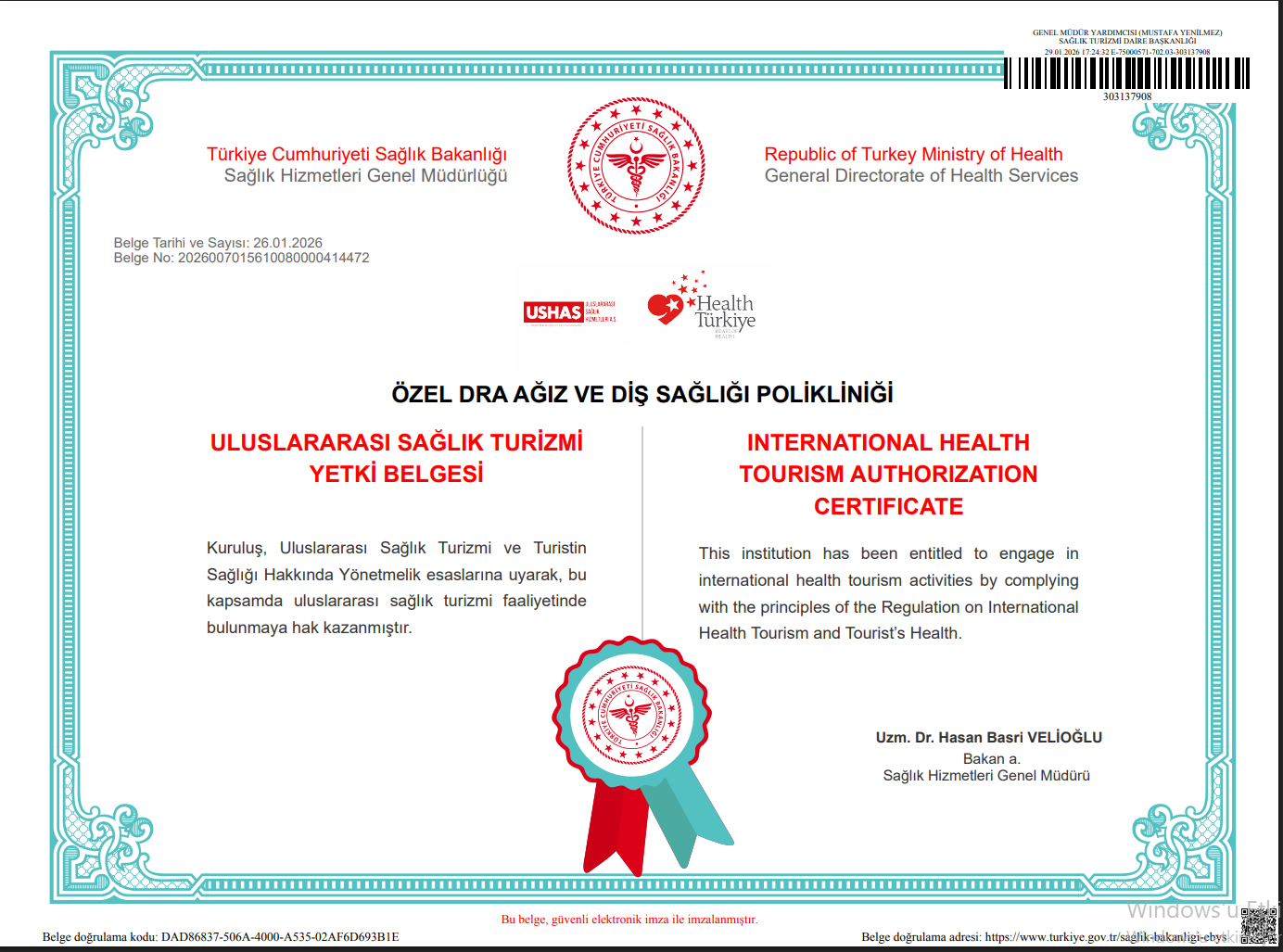
Part of Türkiye's Official Health Tourism Program

Ministry of Health Authorization Certificate
An Honest Path Forward
Smoking raises the real risk around dental implants, and DRA Dental isn’t going to tell you otherwise to get you to book. What we will do is assess your specific case honestly, explain what genuinely helps, and let you make an informed decision rather than either refusing treatment outright or ignoring a real risk factor.
Send your case details via WhatsApp, or get in touch for an honest, case-specific conversation before you commit to travelling.