There’s no upper age limit written into dental implant treatment, and the research backs that up more clearly than most people expect. What actually determines candidacy is your general health, bone volume, and healing capacity, not the number of candles on your last birthday cake. Here’s what the evidence actually shows, and how candidacy is really assessed.
Key Takeaways
- There’s no fixed age cutoff for dental implants, candidacy depends on health and bone volume, not age alone
- A 2025 meta-analysis of 27 studies and 3,892 implants found patients over 75 had a five-year survival rate of 96.8%, actually higher than the 65-75 group’s 92.1%
- Peri-implant bone levels remained stable in older patients despite more frequent plaque, according to the same analysis
- What matters more than age is overall health, bone volume at the specific site, and healing capacity
- DRA Dental assesses this directly with a Day 1 panoramic X-ray and health review, not an age-based assumption
What the Research Actually Shows About Age and Implants
A 2025 systematic review and meta-analysis published in Clinical Oral Implants Research, covering 27 studies and 3,892 implants, compared outcomes between patients aged 65-75 and those over 75. The result runs against the assumption many people bring to this question: patients over 75 had a significantly higher five-year survival rate, 96.8%, compared to 92.1% in the younger 65-75 group. Implant loss rates per 100 implant-years were also lower in the older group. There was no significant difference in success rates between the two groups, and peri-implant bone levels remained stable in the older group despite more frequent plaque and bleeding on probing. The authors’ conclusion was direct: dental implants are a reliable treatment for older adults, including those over 75.
Why Age Alone Isn’t the Deciding Factor
Age is a number, not a diagnosis. What actually determines whether an implant will integrate and function well is bone volume and density at the specific site, general health conditions that affect healing (such as uncontrolled diabetes or certain medications), and whether you can tolerate the procedure itself. A healthy 78-year-old with good bone volume can be a better candidate than a 45-year-old with a long-missing tooth and reduced bone at that specific site. This is covered in more detail in our guide to whether you have enough bone for dental implants, since bone volume, not age, is the actual variable that matters.
Margaret, a 78-year-old from Bristol, had assumed she’d aged out of candidacy after a UK dentist mentioned her bone density “at her age” without elaborating. She’d avoided looking into implants for two years as a result. Her Day 1 panoramic X-ray at DRA Dental showed bone volume within the standard range at every potential implant site, and her general health review raised no concerns that would affect healing. Her treatment proceeded as a standard case, with no age-related adjustment to the plan at all.
What Can Complicate Candidacy, Regardless of Age
Some factors genuinely do affect healing and candidacy, but they’re health-related, not age-related, and they affect patients of any age who have them. Uncontrolled diabetes, certain medications affecting bone healing, smoking, and significantly reduced bone volume at a specific site can all require additional planning or preparation. None of these are exclusive to older patients, and none of them are triggered by a birthday. A 50-year-old smoker with uncontrolled blood sugar faces more real complicating factors than a healthy, non-smoking 80-year-old.
Not sure whether a health condition affects your own candidacy? Send a message via WhatsApp describing your situation, and our dental team can give you a direct read before you assume either way.
How Long Implants Last Doesn’t Change With Your Age at Placement
A dental implant that integrates properly is designed for long-term function regardless of how old you were when it was placed. Our guide to how long dental implants actually last covers this in more detail, implant longevity depends on oral hygiene, bone health, and regular care, not a countdown that resets based on your age at the time of treatment.
What DRA Dental Does to Assess Candidacy Properly
Candidacy is assessed from your actual health and bone volume, not assumed from your age. Our approach:
- A Day 1 panoramic X-ray, showing actual bone volume and density regardless of your age
- A direct health review, looking at the factors that genuinely affect healing, not a birthday-based assumption
- A written treatment plan, reflecting your specific case
- The same implant process and materials used for every candidate, at any age, once your case is confirmed suitable
Results may vary based on individual assessment, and that assessment, not your age, is what shapes your treatment plan.
Practical Steps If You’re Worried Age Disqualifies You
A few things help before you rule yourself out:
- Don’t assume an age-related comment from a previous dentist is the final word, ask for the specific reason behind it
- Send your health history and any existing X-rays via WhatsApp, so our dental team can give you an initial read
- Mention any conditions that affect healing, such as diabetes or long-term medication use, directly rather than assuming they rule you out
- Ask directly whether your age itself is a factor in your specific case, rather than assuming it is
None of this replaces an actual assessment, but it helps you approach your Day 1 consultation with realistic expectations.
Frequently Asked Questions
Is there an age limit for dental implants?
No fixed age limit exists. A 2025 meta-analysis of 3,892 implants found patients over 75 had a higher five-year survival rate (96.8%) than the 65-75 group (92.1%). Candidacy depends on health and bone volume, not age.
Are dental implants safe for elderly patients?
Yes, according to current evidence. The same meta-analysis found peri-implant bone levels remained stable in older patients, and the study authors concluded implants are a reliable treatment for older adults, including those over 75.
What actually determines whether I’m a candidate for implants?
Bone volume and density at the specific site, your general health and healing capacity, and any medications or conditions that affect bone healing, not your age in isolation.
Can I get dental implants in my 70s or 80s?
Yes, provided your bone volume and general health support it, which is assessed directly rather than assumed from your age. Many patients in this age range are standard candidates.
Where is DRA Dental Clinic located?
DRA Dental Clinic is located in Kundu, Lara Beach, Antalya, Turkey.



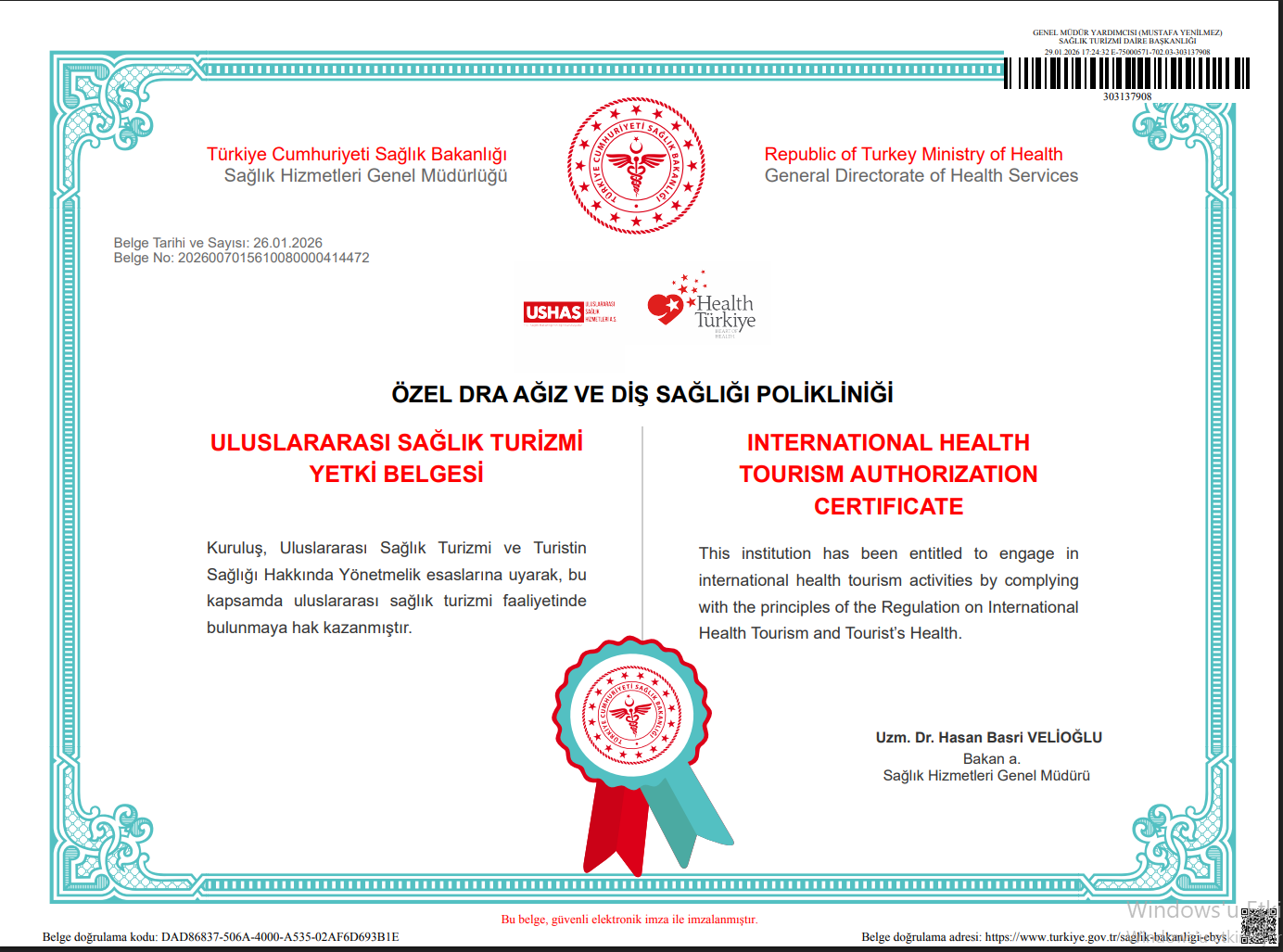
Part of Türkiye's Official Health Tourism Program

Ministry of Health Authorization Certificate
A Realistic Picture
Age alone very rarely disqualifies anyone from dental implants, and the research on patients over 75 actually shows outcomes at least as good as younger implant patients. What matters is a direct assessment of your bone volume and general health, not an assumption based on your date of birth.
Send your health history and any existing X-rays via WhatsApp, or get in touch for an initial read on your own case before you rule yourself out.